This article is for informational purposes only and does not constitute medical or mental health advice. It is not a substitute for professional diagnosis or treatment. If you believe you may be experiencing symptoms of trauma, please consult a licensed mental health professional.
Most people living with complex PTSD do not know they have it.
Something just feels off. Relationships feel harder than they should. Saying yes when they mean no has become second nature. Staying busy keeps the quiet away. And beneath it all sits a kind of exhaustion sleep does not touch.
Because nothing dramatic seems to have happened, or at least nothing they would label as trauma, they assume this is just who they are.
It is not.
What many people are walking around with is not a character flaw or a wiring problem. It is an adaptive response to environments that require them to adapt in order to survive. And it has a name.
This is what complex trauma actually looks like in real life, and what the research and clinical work tells us about what healing from it requires.
What Is Complex PTSD and How Is It Different from PTSD?
Most people have heard of PTSD. Usually, the image that comes to mind is a single event, like a car accident, combat experience, or assault. There is a clear before and after. The nervous system gets stuck responding to something that has technically ended.
Complex PTSD is different in one important way. The threat was not a moment. It was the environment.
Noah Buchanan, a registered associate clinical counselor who specializes in complex trauma and LGBTQIA+ communities, describes it this way. CPTSD develops through chronic, repeated exposure to conditions that were unsafe or unpredictable, often beginning in childhood.
That might look like growing up in a home where the emotional climate was never predictable, experiencing emotional neglect where needs were consistently unmet or dismissed, enduring repeated invalidation of identity or feelings, or living in an environment where you had to scan constantly for someone else’s mood before you could feel safe.
Over time, the nervous system does what it is designed to do. Learning. Adapting. Building a permanent readiness for threat because that readiness was required for survival.
The problem is that the adaptations outlast the environment that produced them.It is worth noting that the ICD-11 (World Health Organization now classifies complex PTSD as a distinct diagnosis from standard PTSD, a recognition of how meaningfully different the two presentations are. Judith Herman’s foundational text Trauma and Recovery first introduced the concept, and Bessel van der Kolk’s The Body Keeps the Score remains one of the most important explorations of how chronic trauma reshapes both mind and body.
CPTSD vs. PTSD
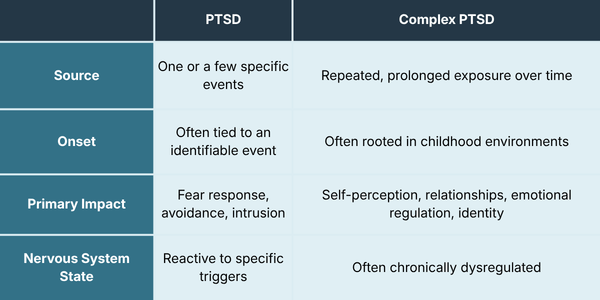
CPTSD does not only affect memory or fear responses. It shapes how someone sees themselves, how they relate to other people, and how safe they feel in their own body. The impact is deeper and wider than a fear response to a single identifiable trigger.
And the most important thing to understand about all of it. These are not weaknesses. They are adaptations. The nervous system did exactly what it was designed to do.
Hypervigilance. People-pleasing. Difficulty trusting. Staying busy.
These aren’t character flaws.
They’re survival strategies that outlived the environment that created them.

How Childhood Trauma Shows Up in Adult Life
Most adults with unresolved childhood trauma are not walking around thinking about their childhood.
They are thinking about why their current relationship feels so hard. Why they cannot seem to hold a boundary. Why they feel this shapeless, sourceless exhaustion that they cannot explain to anyone.
Buchanan sees this consistently in clinical practice. “A lot of people are walking around with childhood trauma that they never named as trauma. They just think this is who I am and this is how I am.”
The patterns are real and the connection to the past is real. It’s the label that is missing.
In Relationships
Relationships are often where it shows up most visibly.
A person with a complex trauma history might struggle to trust others even when there is no current reason not to. They might find that when things get emotionally close, something in them pulls away or shuts down entirely. Or the opposite. They cling, escalate, become hyperattuned to the smallest signs that someone might leave.
This is not a personality flaw. It is a learned nervous system response. When closeness was not safe before, the nervous system files closeness under danger. It does not update automatically when circumstances change.
In Self-Perception
There is often a quiet inner voice that has been running so long it feels like fact.
You are too much. Not enough. You do not belong here.
The hardest part about this voice is that it does not feel like a thought. It feels like an accurate read of reality. People rarely connect it to anything that happened to them. They assume it is the truth about who they are rather than a belief that was installed by an environment that was not safe.
Buchanan is direct about this. That inner voice is not evidence of who you are. It is evidence of what you were told, directly or indirectly, in environments that should have been safe.
In the Body
Trauma is not only psychological. It is somatic.
Chronic tension that has no clear source. Fatigue that does not respond to rest. Gut problems. A sense of disconnection from the body, of moving through the day slightly outside yourself.
These are not random. When the nervous system has been in survival mode for years, the body reflects that. As van der Kolk documents in The Body Keeps the Score, the body holds a record even when the mind has stopped consciously referencing it.

Hidden Signs of Complex PTSD That Look Like Personality Traits
Some of the clearest indicators of complex trauma do not look like trauma symptoms. They look like who someone is.
That is exactly what makes them so easy to miss.
People-Pleasing
The person who cannot say no. Who scans the room to track everyone’s emotional state before attending to their own. Who makes themselves smaller, quieter, less so that others remain comfortable.
This is not a generous personality. It is a survival strategy that started early. When keeping others regulated was the condition for safety, the nervous system learned to prioritize everyone else’s state over its own.
A Complicated Relationship with Anger
Buchanan identifies two common patterns. Someone who cannot access anger at all, or someone whose anger arrives with an intensity that feels disproportionate to the moment.
Both are trauma responses. In one case, anger was dangerous and had to be suppressed. In the other, it has been stored for so long that when it surfaces, it carries the weight of everything that was never allowed to be expressed.
The Need to Stay Constantly Busy
The moment things go quiet, something uncomfortable surfaces. So the person fills every available space with activity, productivity, noise.
Many high achievers are, in Buchanan’s words, “running from something.” The drive is not ambition. It is the discomfort of stillness and what comes with it.
Difficulty Receiving Care
This is one of the most overlooked signs. The person who can show up endlessly for others, who is reliably the one people turn to, but who deflects, minimizes, or disappears when someone tries to show up for them.
Being cared for did not feel safe. So the nervous system learned not to trust it. Receiving care feels more threatening than giving it.
Does This Sound Familiar? A Moment to Reflect
Before reading further, take a moment with these. There are no right answers and this is not a diagnostic tool. It is simply an invitation to notice.
- → Do you find it easier to tune into other people’s moods than your own?
- → When someone offers you genuine care or a compliment, does something in you deflect or dismiss it?
- → Is stillness uncomfortable, do you fill quiet with busyness almost automatically?
- → Have you ever described yourself as “bad at relationships” or “too sensitive” without connecting it to anything specific?
- → Does the inner voice that critiques you feel more like fact than opinion?
- → Do you feel a kind of exhaustion that rest does not seem to touch?
If several of these landed, that is worth taking seriously. Not as a diagnosis, but as information. Finding a trauma-informed therapist who understands these patterns is a meaningful next step.
Why People Say “My Trauma Wasn’t Bad Enough”
This is one of the most consistent things Buchanan hears from clients. “But my trauma wasn’t bad enough.”
The comparison is almost universal. Someone else had it worse. Nothing dramatic happened. There was no single event they can point to. So they conclude they are not entitled to the weight they carry.
That belief is not evidence that they are fine. It is part of the pattern.
Complex trauma often operates precisely in the absence of dramatic single events. It builds through accumulation. The slow drip of emotional unavailability, the repeated experience of not being seen, the environment that was never quite safe enough to relax in. None of those individual moments looks like real trauma. Together, they absolutely are.
You do not need the worst story in the room to have a nervous system that needed to adapt in order to survive.
There is also, Buchanan notes, the reality of systemic trauma. The accumulated psychological impact of living in environments that devalue who you are based on identity. For many people, including many in LGBTQIA+ communities, the hidden signs of unresolved childhood trauma are compounded by the daily reality of navigating a world that has communicated, repeatedly and structurally, that who they are is not fully acceptable.
That does not require a single dramatic event either. It builds the same way. And it has the same effects.

What Healing from Complex Trauma Actually Looks Like
Most people expect healing to look like the pain disappearing.
That expectation causes real harm because it leads people to conclude they are not healing when they actually are.
Buchanan reframes it clearly. “People expect healing to look like the pain is gone. That’s not usually how it works.”
Here is what healing from complex PTSD actually looks like in practice.
You Start Noticing Your Patterns
Not fixing them. Not eliminating them. Noticing them.
“I just did that thing again where I shut down. And I caught it.”
That small moment of awareness is new. The gap between the trigger and the reaction did not exist before. Creating it is the beginning of everything.
The Space Between Trigger and Reaction Grows
Something happens. And instead of an immediate, automatic response, there is a pause. Small at first. But there.
That pause is where choice lives. It is, in clinical terms, the window of tolerance beginning to expand. It is the nervous system learning, slowly, that it has options.
You Feel Safe Enough to Feel
Many people with complex trauma are disconnected from their emotions because emotions were not safe. Feeling things led to consequences.
When someone in therapy starts to cry in session, or accesses anger they have been sitting on for years, that is not a breakdown. Buchanan’s clinical supervisor put it this way. It is always a victory when you see a client cry. Because it means something in them felt safe enough to come through.
You Start Letting People In, Even Imperfectly
Not fully. Not without fear. But a little more than before.
For someone whose nervous system has filed closeness under danger, allowing any connection in represents an enormous shift. It does not have to look perfect. It just has to be a little more than it was.
The Inner Voice Begins to Soften
It does not disappear. Not at first. But it becomes less absolute. Less relentless. There are moments where it is quieter than it used to be.
Buchanan describes this as one of the most significant and most overlooked signs of healing. “When that inner voice that’s been so cruel for so long starts to soften even slightly, that’s healing.”

Find a therapist who fits your needs
TeleWellness Hub brings together qualified therapists and telehealth providers in one place. Browse profiles, explore specialties, and choose someone who feels right for you.
When Trauma Intersects with Identity
For some people, the chronic threat was not only about family dynamics or household instability. It was also about being in a world that responded to who they are with rejection, invalidation, or hostility.
For many transgender individuals, for example, the chronic stress that produces complex trauma symptoms is not internal. It comes from repeated experiences of misgendering, family rejection, safety concerns in everyday spaces, and an environment that made it consistently clear that who they are is not acceptable.
This is not distress caused by identity. It is distress caused by the world’s response to identity. And it produces the same nervous system adaptations that any other form of chronic threat produces.
Understanding that distinction matters both clinically and personally. To understand more about why trans people face higher rates of anxiety and depression and what affirming care actually requires, the full context is worth exploring.
How to Find Support That Does Not Make Things Worse
If you have had a bad experience in therapy, hesitation makes sense. That experience is information.
Many people with complex trauma histories have sat with clinicians who did not understand what they were dealing with, who pathologized their responses, or who moved too fast without building the safety that complex trauma work requires.
The right support exists. It looks different from what those experiences might have suggested.
A therapist who is genuinely equipped for complex trauma will understand that your responses are adaptations and not disorders, know that healing requires safety before it requires processing, not require you to justify your history or minimize it to make sense of it, have fluency in how the nervous system works and not just how thoughts work, and move at a pace regulated by your window of tolerance rather than a protocol.
You are allowed to ask questions before committing to a therapist. You are allowed to be selective. Finding the right fit is not being difficult. It is being accurate about what this work requires.
What to Say When You First Reach Out to a Therapist
It can help to have language ready. Here are some ways to start.
“I think I may be dealing with complex trauma, though I have never been formally diagnosed. Finding a therapist with a trauma-informed approach feels important.”
“I have had experiences in therapy that felt invalidating. A therapist who understands trauma as a nervous system response would be a better fit.
“I am not sure how to describe what I am carrying, but I know something feels chronically off. Hoping to work with someone who will not require me to have the right story before they take it seriously.”
If you are looking for clinicians who approach complex trauma from this framework, TeleWellness Hub connects people with trauma-informed providers who understand what you are navigating without requiring you to start from scratch.
Buchanan has also developed a free psychoeducation workbook for survivors called Understanding CPTSD, published through their initiative the Transcend Stigma Project. It goes deeper into each symptom cluster, includes reflection prompts, and is written directly to survivors rather than about them. It is worth reading alongside this article, especially if you are not yet in therapy or want something to bring into a session.
You Do Not Need the Worst Story to Deserve Help
If you have spent years quietly wondering whether what happened to you was bad enough to justify the weight you carry, that question itself is part of the pattern.
Complex trauma does not require a dramatic origin story. It requires a nervous system that had to adapt in order to survive an environment that was not consistently safe. That is the threshold.
There is nothing to prove. Healing is not reserved for people with the worst stories. Struggling is enough, and support should be available without qualification.
Healing from complex trauma is possible. It is not fast. It is not linear. But the things that mark its progress, the growing awareness, the widening gap between trigger and reaction, the slight softening of the inner voice, are real. They accumulate. And they matter more than most people recognize while they are happening.
If this resonated and you are considering finding support, TeleWellness Hub connects people with trauma-informed clinicians who understand complex PTSD not as a checklist of symptoms but as a lived pattern that requires a specific kind of care. You can search by specialty and find providers who approach this work the way it deserves to be approached.
Frequently Asked Questions
Complex PTSD (CPTSD) is a trauma response that develops from prolonged, repeated exposure to threatening or unsafe conditions rather than a single event. It most commonly originates in childhood environments that were emotionally unpredictable, neglectful, or invalidating, but it can also develop from sustained adult experiences of abuse, captivity, or identity-based persecution. The nervous system adapts to chronic threat by staying in a state of heightened alert, and those adaptations persist even after the threatening environment ends.
PTSD typically follows one or a few specific traumatic events and centers on fear responses, avoidance, and intrusive symptoms tied to those events. Complex PTSD develops from sustained, repeated exposure to threat over time, often starting in childhood. Its effects are broader. It disrupts self-perception, emotional regulation, relationships, and the sense of safety in one’s own body. People with CPTSD often struggle with a persistent negative self-image and difficulty trusting others in ways that go beyond standard PTSD presentations. The ICD-11 now recognizes CPTSD as a distinct diagnosis, though it does not yet appear as a standalone entry in the DSM-5.
Yes, and it is more common than most people realize. Because CPTSD develops gradually rather than from a single identifiable event, many people carry its patterns without ever connecting them to trauma. They identify as having trust issues or being bad at relationships or too sensitive, without recognizing these as adaptive responses to earlier environments. The absence of a dramatic origin story often leads people to conclude they do not qualify, which is itself part of the clinical picture.
The signs most often missed because they look like personality traits include chronic people-pleasing and difficulty setting limits, either an inability to access anger or anger that arrives disproportionately, the compulsive need to stay busy to avoid stillness, difficulty receiving care or support from others, a persistent inner critic that feels like factual self-knowledge rather than a learned belief, chronic physical symptoms like fatigue or tension, and an underlying sense of not belonging or being fundamentally different from others. For a deeper look, see hidden signs of unresolved childhood trauma.
Healing from CPTSD rarely looks like the absence of pain. It looks like noticing a pattern you previously acted on automatically, a growing pause between a trigger and your response to it, the ability to feel emotions that previously felt inaccessible or unsafe, allowing people closer even when it is uncomfortable, and a gradual softening of the inner critical voice. These changes are often quiet and incremental. They do not always feel like progress while they are happening. But they are measurable, and they accumulate over time.
Look for clinicians who describe their work as trauma-informed, somatic, or attachment-based. You are entitled to ask directly how they approach complex trauma that does not have a single identifiable event. A good fit will not require you to justify your history. TeleWellness Hub allows you to search by specialty and find providers who approach complex PTSD from this framework.

About the Expert
This article draws from a clinical conversation with Noah Buchanan, APCC, a registered associate professional clinical counselor at Foresight Mental Health and founder of the Transcend Stigma Project. Buchanan is a transgender clinician who specializes in complex trauma, LGBTQIA+ affirming care, and liberation-focused practice. They co-host the Trans Narrative Podcast, and have developed a growing library of free clinical and survivor resources
View Noah’s profile on TeleWellness Hub